Cyprus's Water Crisis is turning into an EU Funding Race
Aug. 17, 2026
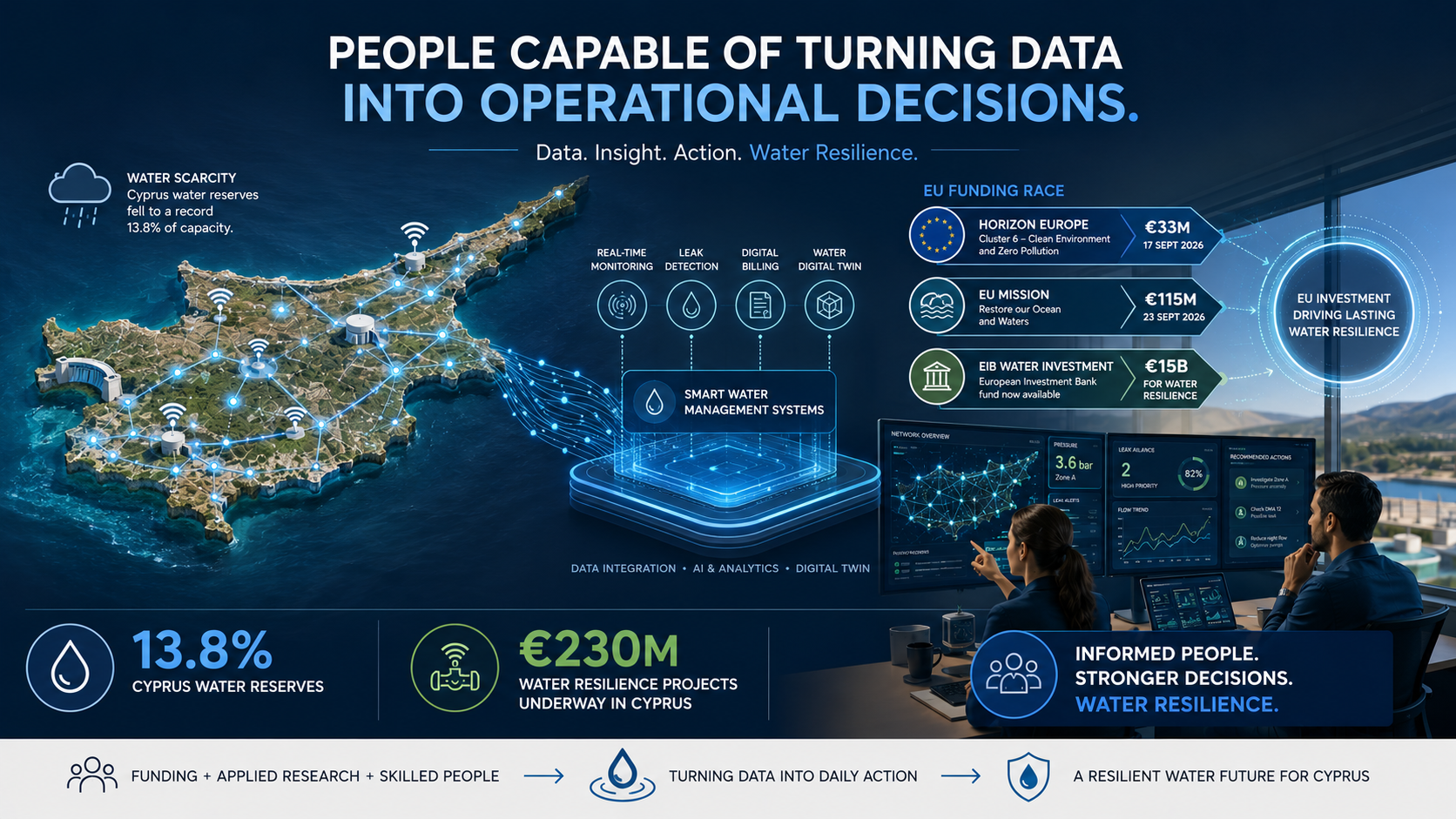
In February 2026, Cyprus's water reserves fell to a record 13.8% of capacity, a figure we covered in detail when we last wrote about the island's leak-detection challenge on this site. That crisis hasn't gone away; instead, the response to it is now visibly turning into something else too: a funding race, with real money and real deadlines attached.
The clearest sign is the scale of investment now moving through Cyprus's water sector. €230 million worth of water infrastructure, technology and water-resource management projects are currently underway, co-financed by the EU under the Thaleia 2021–2027 Cohesion Policy Programme. Alongside new reservoirs and pipeline replacement, the package includes €18 million for smart water management systems in Paphos and Nicosia, specifically for real-time monitoring, leak detection and digital billing. That local spending sits inside a much larger EU framing: at a February 2026 briefing during the Cyprus's Council presidency, the EU's water resilience commissioner described investing in water as investing in economic security, and pointed to a new €15 billion European Investment Bank fund now available for exactly this kind of project. Money like this doesn't move quietly. It moves toward organisations that can already show they know how to spend it well.
That's where this coming September comes in! Horizon Europe's Cluster 6 "clean environment and zero pollution" call closes for single-stage proposals on 17 September 2026, with €33 million across three topics, one of which, being the managed aquifer recharge, sits squarely in the water-resilience space. A week later, on 23 September, the EU Mission "Restore our Ocean and Waters" closes a €115 million round across five topics, including digital-twin-ocean development work that connects directly to inland water monitoring. It's the same September crunch showing up across the EU funding calendar this year, and Cyprus's water sector just happens to be one of the places it lands hardest.
PHOEBE in the Water Horizon (pun intended…)
PHOEBE's own position in this space isn't new. PHOEBE has been working within WATERVERSE, a Horizon Europe project building a Water Data Management Ecosystem across six European pilot countries, including Cyprus, where the local demonstration focuses on water digital-twin and analytics tools. In October 2024, PHOEBE co-organised a Multi-Stakeholder Forum in Larnaca alongside the KIOS Research and Innovation Centre of Excellence at the University of Cyprus and the Limassol District Local Government Organisation, bringing together water boards, regulators and technology providers around exactly the kind of data-sharing questions the EU's Water Resilience Strategy is now trying to solve at scale. It's applied, commercial-facing work, not academic research for its own sake, and it sits alongside the platform-level engineering PHOEBE has already written about in the leak-detection piece linked above.
What tends to get less attention, however, in coverage of funding announcements and project consortia, is the layer underneath all of it: someone still has to look at a dashboard flagging an anomalous pressure reading or an unexplained gap in a district metered area, and know what it actually means for that day's operations. That's a genuinely different skill from writing the Horizon proposal that funded the sensors in the first place. It's also, not coincidentally, the gap a small but growing number of practical short courses are starting to address, including an HRDA-subsidised vital importance seminar running this October built around applying AI and IoT to everyday operations rather than around engineering theory.
None of the September CFP deadlines above will fix a reservoir on their own, and none of the funding flowing into Cyprus this year will mean much without people on the ground who can turn a data platform into a daily decision. The combination of funding, applied research and the people who can act on both, is what will actually determine whether a water-resilience strategy shows up as a policy document or as a system that works.