Water Under Pressure: Why Cyprus and the EU need Smarter Leak Detection… Now
July 22, 2026
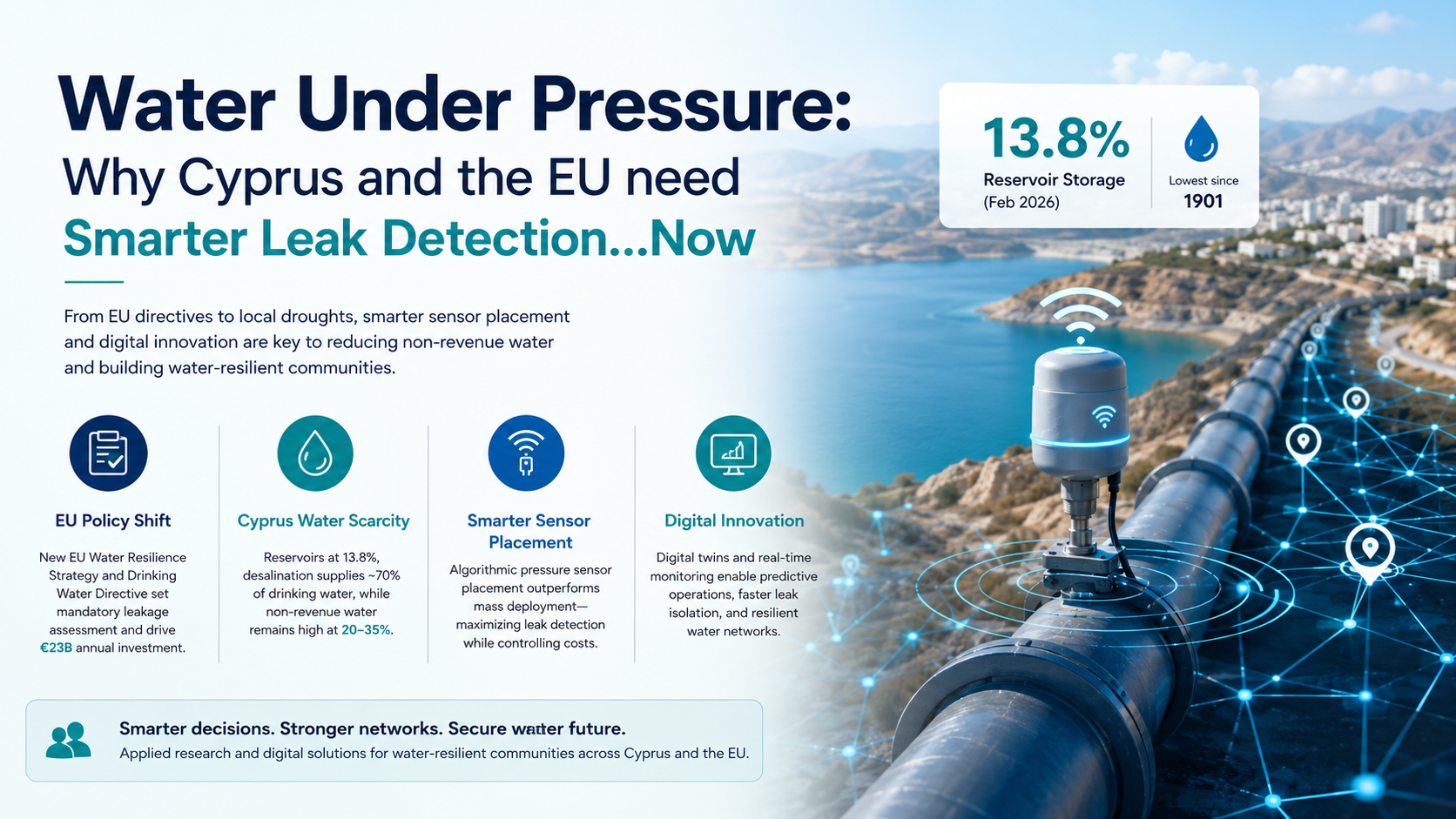
Water resilience is now an urgent European economic-security priority. Driven by the EU Water Resilience Strategy, an annual EU water infrastructure investment gap of €23 billion, and strict Drinking Water Directive leakage assessment mandates, non-revenue water reduction has moved from a maintenance goal to a regulatory imperative.
In Cyprus, acute water scarcity and reservoir levels at 13.8% make smart water network Cyprus deployments essential. PHOEBE leads applied water research initiatives, translating Horizon Europe research on water networks into cost-effective leak detection sensor placement and hydraulic network optimisation for modern water utilities.
1. EU Policy Shift: Drinking Water Directive Leakage Assessment and the EU Water Resilience Strategy
European water policy has fundamentally shifted toward regulatory urgency and structural digitalisation. On 4 June 2025, the European Commission adopted the landmark EU Water Resilience Strategy, establishing a "Water Efficiency First" mandate.
Supported by the European Parliament's resolution emphasizing urgent leak repairs, the strategy addresses Europe's persistent EU water infrastructure investment gap of €23 billion per year. To support this transition, the European Investment Bank committed €15 billion between 2025 and 2027 through its Water Resilience Programme.
2. Cyprus Water Scarcity: The Case for Smart Water Network Deployment
Cyprus serves as the acute frontline example of severe water stress in Southern Europe. Following the 2025 Cyprus drought water management crisis, the worst drought recorded since 1901, dam inflows dropped to historic lows. By February 2026, total reservoir storage fell to just 13.8% of capacity.
To maintain supply, Cyprus desalination reliance has surged, with desalinated plants supplying roughly 70% of drinking water. However, Cyprus non-revenue water loss remains high at 20–35%, driven by physical pipe fractures and metering inaccuracies. Multiple 2025 reports by the Audit Office of Cyprus revealed significant oversight gaps, unverified intake points, and disconnected telemetry systems across municipal water boards.
To address these vulnerabilities, water leak detection projects are expanding rapidly:
- Limassol Living Lab: A €13 million smart water network project funded via the EU Recovery and Resilience Plan, deploying 80,000 smart meters and continuous pressure and water-quality sensors.
- Paphos IoT/SCADA Deployment: Implementation of 27,000 smart meters, District Metered Area (DMA) segmentation, and continuous monitoring across critical network nodes.
3. Where to Place Pressure Sensors in a Water Network: Hydraulic Network Optimisation
A core technical challenge facing utility engineers is where to place pressure sensors in a water network to maximize leak detection sensitivity without incurring prohibitive hardware costs.
Recent peer-reviewed research (Tornyeviadzi et al. (2024), Wu et al. (2025), Rajabi & Tabesh (2024), Pérez et al. (2009)) confirms that algorithmic pressure sensor placement optimisation achieves superior results compared to mass sensor deployment. Advanced water loss reduction technology focuses on algorithmic placement over raw sensor count. These scientific findings validate PHOEBE’s approach: cost-effective leak detection sensor placement depends on mathematical algorithms that identify critical network nodes.
4. Digital Twin Water Network EU and Applied Water Research in Cyprus
Across Europe, utilities are transitioning from reactive maintenance to predictive digital models. Building a digital twin water network allows utilities to simulate pressure dynamics, isolate bursts and automate water distribution network monitoring in real time.
PHOEBE bridges the gap between academic innovation and market execution through:
Applied Water Research in Cyprus: Translating complex mathematical modeling into scalable, user-friendly software tools for municipal water authorities.
Smart Water Management Research and Innovation: Leading regional research to resolve complex hydraulic challenges in water-stressed environments.
Water Network R&I Horizon Europe Collaboration: Partnering within European funding frameworks (such as Horizon Europe) to commercialize algorithm-driven leak detection.
To learn more about PHOEBE's software solutions for hydraulic network optimisation and smart water management, visit PHOEBE Innovations.