SIEQUA-VET, AI agents and building operations. Who is training the operators?
Oct. 30, 2026
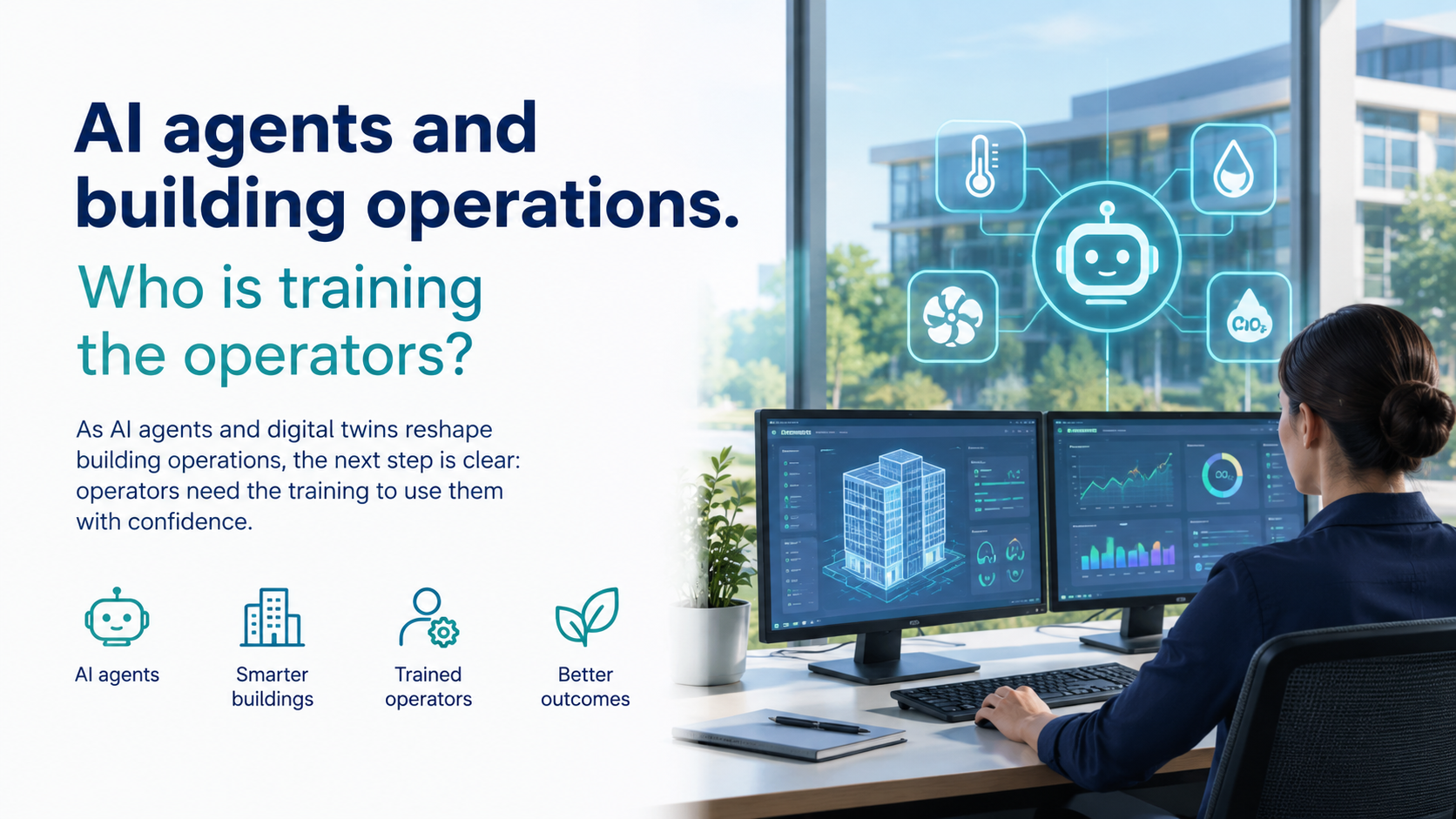
Honeywell's new agent platform lets operators decide how much autonomy to grant. That makes operator training the next question; this is the focus of the SIEQUA-VET project meeting and workshop in Athens on 3 and 4 November.
On 14 October, Honeywell Technologies introduced Forge Cognition, a platform that places AI agents and real-time digital twins on top of the systems that heat, cool and ventilate buildings. The company reports early pilots at sites including NVIDIA's Voyager campus in California, where alarm-handling agents are credited with reductions of up to 90% in unnecessary alerts, while a comfort score stayed above 95%.
These are vendor-reported pilot figures, and the energy claim is a potential saving of up to 10%, not a measured one. Even so, the announcement is a clear marker of where building operations are heading.
The detail that matters for indoor environments
Honeywell describes its comfort score as a weighted average of temperature, humidity and CO2 across zones. In other words, indoor environmental quality (IEQ) is what the agents are being judged on. The platform can run in manual, semi-autonomous or autonomous mode, and operators set the level of oversight and can override it at any time.
What the human in the loop needs to know
An agent that sorts alarms is only useful if someone can judge whether it sorted them well. That takes specific knowledge. Is a reading measured or estimated from other data? Which reference is a CO2 limit based on, given that standards express it differently, some relative to outdoor air and others as absolute values? What was the baseline behind a reported saving? None of these questions needs a data science degree, but all of them need training and building operators rarely receive it.
The above extends two arguments we made earlier this year: that trust in building AI depends on interpretability and that the workforce behind smart buildings is a precondition, not a side effect.
SIEQUA-VET: training for the operator's seat
SIEQUA-VET (Micro-credentials Training for Building Operators on Sustainable Indoor Environmental Quality) is an Erasmus+ small-scale partnership in vocational education and training, coordinated by PHOEBE together with EUFORA (Greece) and EUROCONSULTING (Bulgaria). The partnership is developing four training modules, with the aim of accreditation as micro-credentials, for building owners and operators, primarily in tourism and hospitality but also in large office buildings. The material includes simulation scenarios.
Athens, 3 and 4 November
The SIEQUA-VET consortium will meet in Athens, Greece on Tuesday 3 and Wednesday 4 November for the project's second transnational project meeting (TPM2) and to deliver a training workshop. The workshop will introduce participants to SIEQUA-VET and to the training material developed so far, including simulation scenarios. It is open to external participants and doubles as a pilot: feedback from the room will inform the final versions. All material will be published as open educational resources (OER).
Harnessing AI and the Internet of Things for smart(er) building operations
On 24 and 25 October 2026, Dr Ryan Grammenos led an HRDA-approved seminar on harnessing AI and IoT for sustainable environments in Platres, with 23 professionals from 16 organisations. The two share a premise, that building and indoor environmental data make a practical classroom, and that the person reading the data has to understand it.
For PHOEBE, which turns applied research into commercial products, the lesson is practical. Agents for buildings will arrive in stages, and Honeywell itself says capabilities will expand over time. Each stage will need operators who can question what the system tells them, so the training should be ready before the technology is.