Cutting through the AI hype in Smart Building Management
Aug. 5, 2026
Artificial Intelligence (AI) has become the default answer to almost every question about the future of building management. Ask about energy savings, safety or operational efficiency and "AI" is usually part of the response. Yet for many professionals in the buildings’ environment, such as engineers, facility managers, developers and the SMEs that serve them, the term has grown so broad it risks losing its meaning.
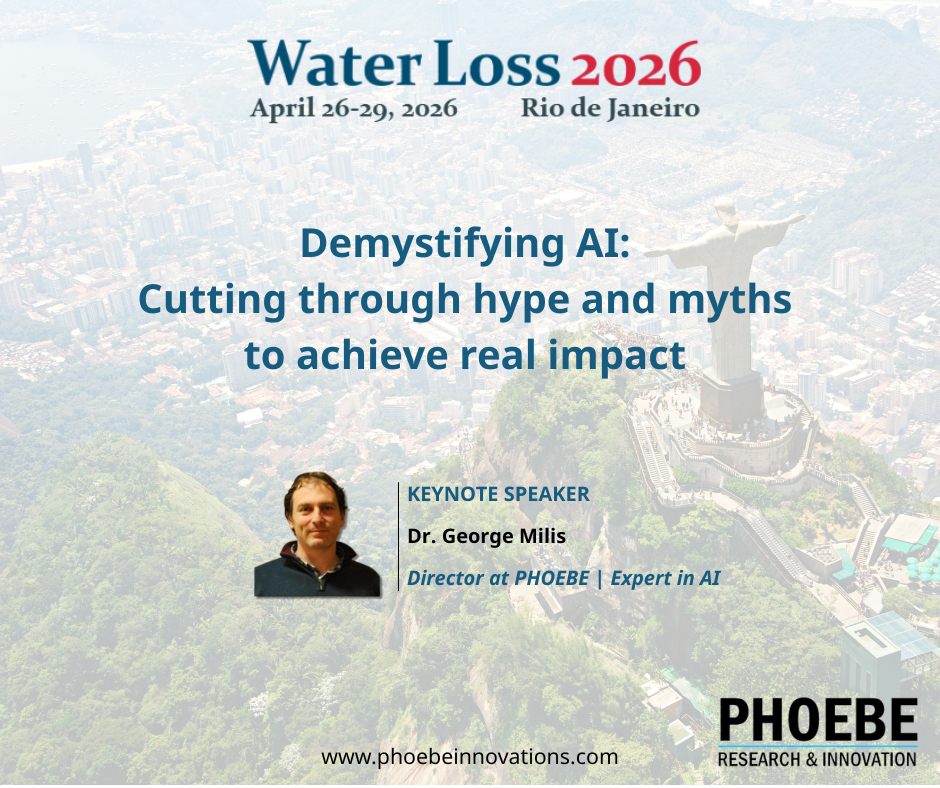
This challenge is not unique to buildings. Earlier this year (April 2026), our Director, Dr George Milis, addressed it in a keynote talk at the WaterLoss 2026 Conference in Rio de Janeiro, organised by the IWA Water Loss Specialist Group. His talk, "Demystifying AI: Cutting through hype and myths to achieve real impact", argued that the water sector's AI conversation needed to move past buzzwords and toward a grounded understanding of which specific techniques solve specific problems.
The same reframing is overdue in smart building management. The sector does not need less AI, it needs a clearer view of what AI actually is, where it is already delivering measurable results and where the label is doing more to obscure than to inform.
Moving beyond the buzz: what's actually working
Strip away the marketing language and a handful of well-defined techniques are already changing how buildings are controlled and maintained.
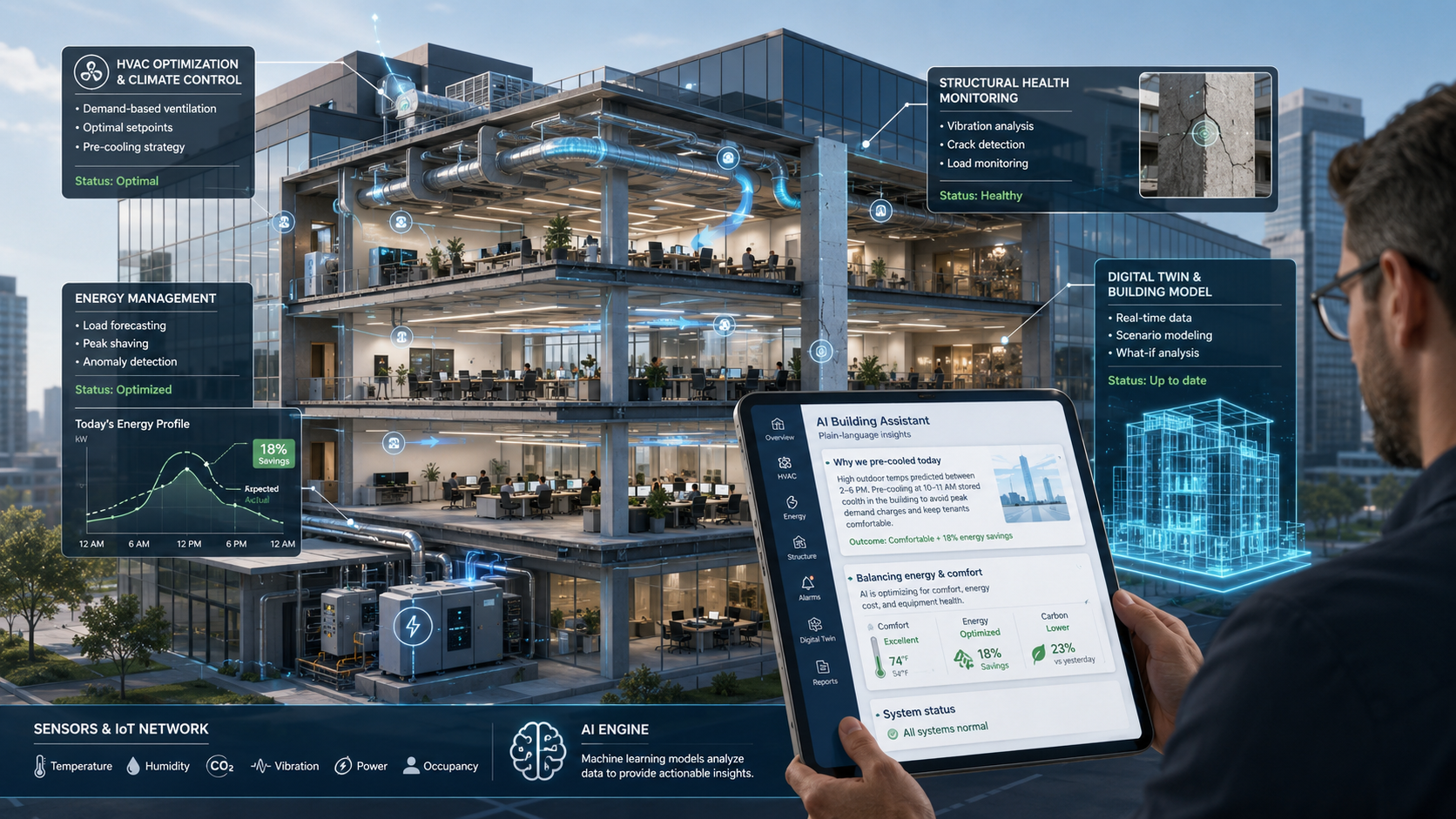
In HVAC and systems optimization, machine learning-driven control methods offer to balance occupant comfort against energy efficiency around the clock, adjusting to real-time conditions rather than fixed schedules. In more complex environments, subway stations being a notable example, reinforcement learning techniques provide model-free optimal control, where rule-based systems struggle.
This shift is also changing how savings are verified. The industry is moving from periodic measurement and verification toward real-time monitoring and targeting, with AI-based frameworks now enabling continuous verification of demand-side savings, rather than retrospective audits.
Specific techniques are applied to address specific challenges, producing measurable outcomes, precisely the standard that should define any serious AI conversation.
Where the Buildings’ sector is heading
Looking toward the future, industry leaders are converging on a similar conclusion: successful AI adoption depends less on the sophistication of any single model and more on the foundations underneath it. High-quality, organised data is increasingly seen as the critical prerequisite for success and unified platforms are beginning to replace the fragmented "point solutions" that have characterised the sector to date. True building intelligence also depends on physical infrastructure being in place first, i.e., reliable sensing, control and actuation systems.
Agentic AI, capable of acting autonomously to achieve defined goals, is emerging as one of the sector's significant trends. Its adoption, though, will only succeed alongside deliberate change management. Firms are being encouraged to build communication strategies that support cultural buy-in, rather than assuming the technology will adopt itself.
Further out, the next stage involves modelling buildings at the physics level and using Digital Twins to simulate performance with far greater accuracy than current approaches allow.
The trust gap: why interpretability matters
Perhaps the most important parallel to Dr Milis's keynote lies here. As AI systems take on more autonomous control over building operations, a "trust gap" has opened around black-box machine learning models: a reluctance among operators to rely on decisions they cannot understand.
This must be addressed carefully. New frameworks generate human-understandable narratives explaining why a system made a particular control decision. LLMs supported by well-defined deterministic tools increasingly interpret complex sensor data and give operators plain-language answers, explaining, for example, why a building was pre-cooled ahead of a demand response event.
This matters beyond convenience. As optimisation and monitoring become more AI-driven, questions of liability follow: who is accountable when an autonomous system fails? Managing AI risk must be a top priority for real estate leaders precisely because trust and compliance depend on it. Deploying intelligence at the edge, directly on-site, is also proving vital for the real-time responsiveness building management systems require.
Choosing the right tool for the real problem
The lesson from recent industrial research is not that AI is overstated; it is that treating "AI" as a single, undifferentiated technology obscures the real work of matching specific methods to specific problems. Reinforcement learning for HVAC control, neural networks for forecasting of air quality parameters, Bayesian networks for fatigue prediction and explainable frameworks for operator trust are not interchangeable, but they are distinct tools solving distinct problems, each with its own evidence base.
For tech companies, developers and SMEs operating in this space, the opportunity is not to chase the AI narrative, but to get specific: identify which established technique addresses a genuine operational challenge and build or buy accordingly. That is how hype gives way to real impact, across domains where we work and live.