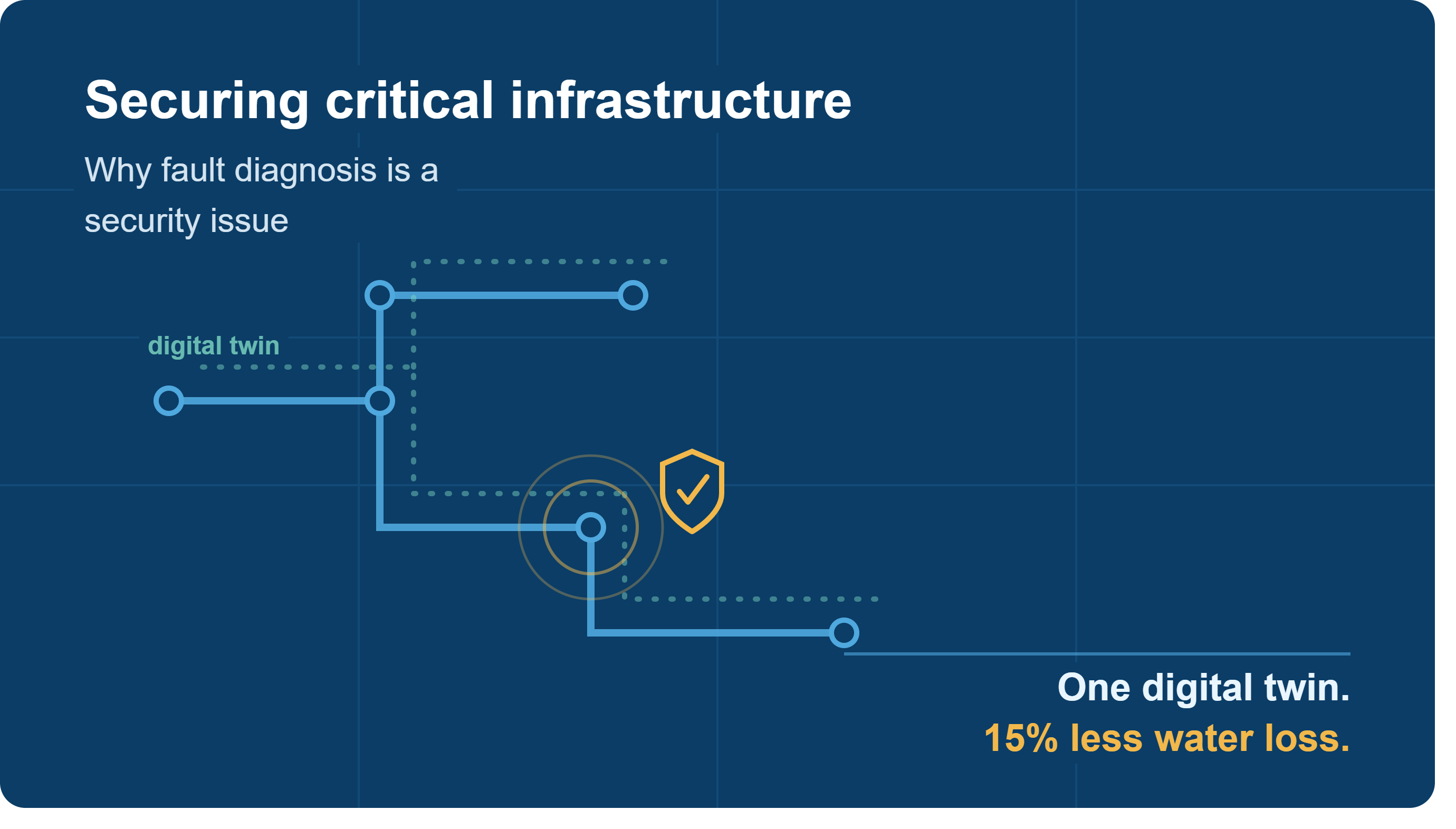
Securing critical infrastructure: why fault diagnosis is a security issue
Oct. 2, 2026
On 12 December 2024, the European Commission's Digital Strategy office named WATERVERSE a success story. The figures were concrete: a 15% cut in water losses and a 10% drop in electricity costs from optimised pump scheduling, demonstrated across pilots in six countries over the project's three years. One of those pilots ran in Cyprus, built and operated by PHOEBE.
Water loss sounds like an efficiency statistic. It is also, less obviously, a security one.
WATERVERSE set out to solve a problem that sounds almost bureaucratic: water utilities don't share data with each other, or even within themselves, as well as they should. The project's own documentation names the reason plainly, utilities worry about confidentiality leakage and about the security aspects of critical infrastructures whenever data starts moving between systems. That hesitation isn't paranoia. A water network is a physical system controlled by digital commands, pipes, pumps and valves responding to software. When the data describing that system is mishandled, the risk stops being theoretical.
PHOEBE's contribution to WATERVERSE was the Cyprus pilot: a Digital Twin, a live virtual model of a real water distribution network, paired with our tool, WaterAnalytics. Feed the twin real-time data from the physical network, and it becomes possible to tell normal variation apart from a genuine problem, quickly enough to act on it, rather than finding out weeks later from a bill or a burst main.
That distinction, between noise and signal, is what fault diagnosis means in practice. A pressure drop somewhere in a network could be a burst pipe, a valve left open, or nothing at all, just ordinary demand fluctuation. Without a system built to tell those apart, every anomaly either gets ignored, which is how real faults go unnoticed, or triggers an alarm, which is how operators learn to tune alarms out. Both failure modes leave the same blind spot behind, one that bad actors or simple unchecked errors can hide inside.
This isn't only a water problem. PHOEBE's ANTS project, completed at the end of June, applies the same underlying logic to buildings: a self-learning system managing HVAC in real time, accounting for solar generation and battery storage, developed with Lelantus Innovations and the KIOS Research and Innovation Center of Excellence at the University of Cyprus. And in the energy sector, the Horizon Europe project SOCIAREM, where PHOEBE leads the IoT infrastructure for the Cyprus Energy Community pilot, depends on the same requirement: sensors and data acquisition systems that can separate a genuine event from background noise, across a network of citizen-owned solar installations rather than a single utility.
The thread connecting all three projects isn't a shared technology. It's a shared design question: when something in a large-scale system looks unusual, how quickly, and how reliably, can you explain why.
WATERVERSE answered that question for water data specifically, by building infrastructure where secure data sharing and fast anomaly detection reinforce each other instead of trading off. For anyone responsible for infrastructure that is both physical and digital at once, that's a model worth paying attention to.