Beyond Awareness: Building Community Readiness for the Energy Transition
July 6, 2026
A reflection on what it truly takes for communities to lead their own energy future; and why CITIZEMP is designed around exactly that question.
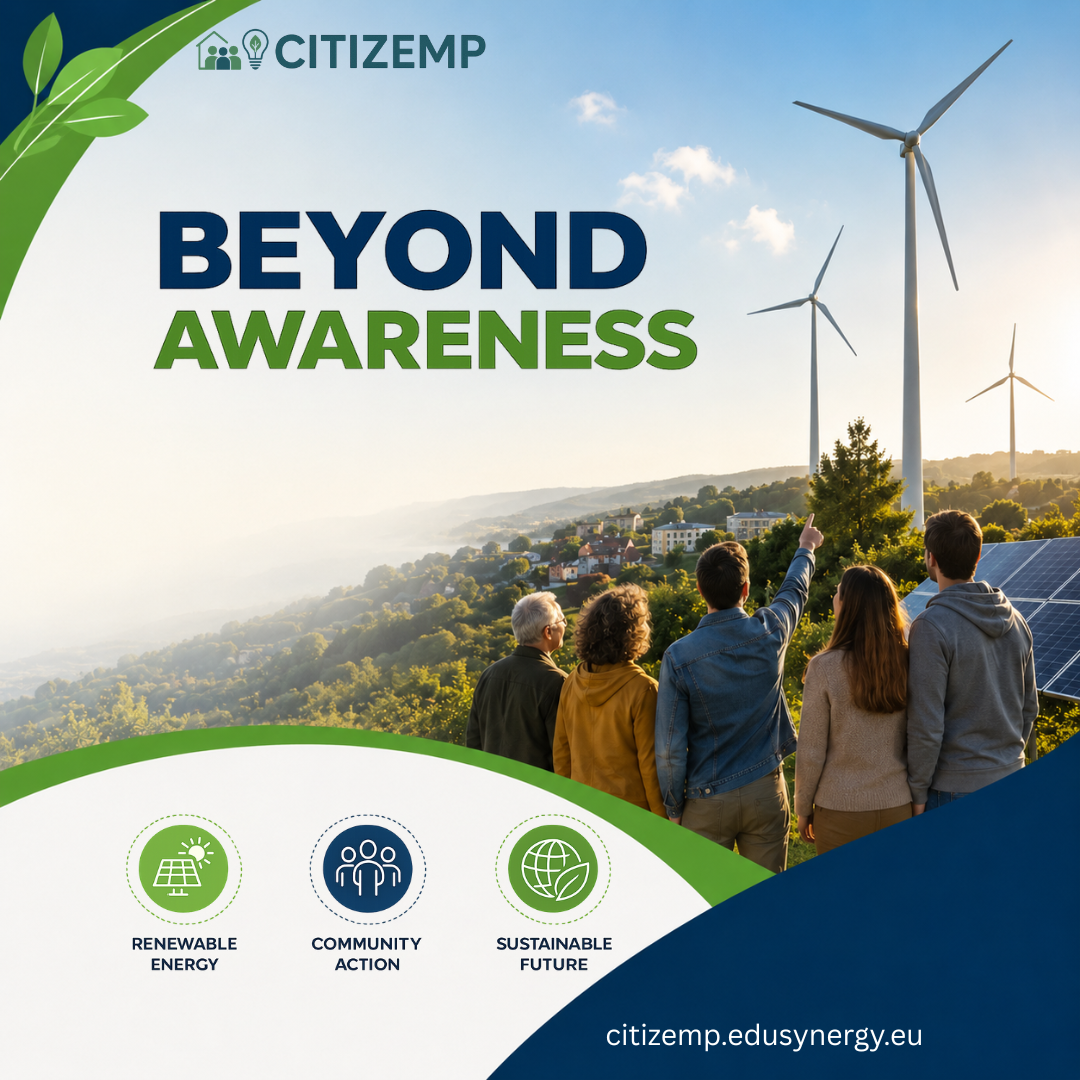
Raising awareness about renewable energy is necessary, yet it is not sufficient. This is one of the clearest lessons emerging from the growing body of practice around community energy, and it is a lesson that should sit at the heart of the CITIZEMP project.
A recently published article by Community Energy Pathways, which is a UK-based organisation with fifteen years of experience supporting local energy initiatives, puts it plainly: community readiness is "how prepared a community is to organise itself to tackle an energy challenge and successfully develop local energy projects" The phrase organise itself is the vital and operative one. Awareness tells people something is possible; readiness, however, is what allows them to actually do it!
CITIZEMP was designed with this distinction in mind. Across Cyprus, Greece and Bulgaria, our consortium is not simply running information campaigns. We are working with local communities, municipalities and energy practitioners to build the conditions under which genuine community-led energy action becomes possible; and sustainable.
Three Pillars, Three Countries
Community Energy Pathways describes community readiness as resting on three interconnected pillars: community capacity (do people have the skills and resources to act?), community motivation (do people believe collective action can make a difference?), and system readiness (is the wider local ecosystem, including local authorities, businesses, training providers, aligned and prepared to support them?).
What is striking about this framework is how precisely it maps onto what CITIZEMP has observed through its Participatory Design Workshops conducted in all three partner countries. Communities across our project territories share a common pattern: motivation is rarely the problem. People care about energy costs, about local sustainability, about leaving something better for the next generation. What is often missing is the first and third pillars being the organisational capacity and the supportive local systems that turn that motivation into tangible action.
This is what our Energy Champions programme is designed to address. By equipping community members with practical skills, technical literacy, facilitation, communication, project planning, CITIZEMP is directly investing in community capacity. And by connecting those champions to local authorities, municipalities and energy communities already operating in the field, the project is also working to strengthen system readiness.
Volunteering at the Core
The community capacity pillar deserves particular attention because it includes something that can easily be overlooked in project planning: volunteer capacity. Community energy, by its nature, depends on people who are willing to give their time without immediate financial return. This is not a weakness of the model; it is one of its defining strengths, because it is the mechanism through which communities develop genuine ownership of their own energy futures.
In our own consortium, the Municipality of Athienou stands as a living example of what volunteer-driven community engagement can achieve. The municipality's model, built on deep local trust, active civic participation and a culture of collective problem-solving, demonstrates that communities do not need to wait for top-down infrastructure before they begin. They need the confidence, the skills and the organisational structures to move. CITIZEMP's phygital hubs are intended to provide exactly those structures: accessible, community-anchored spaces, physical and digital, where knowledge flows, questions are asked and action is planned.
Minoan Energy Community in Crete Proves the Point
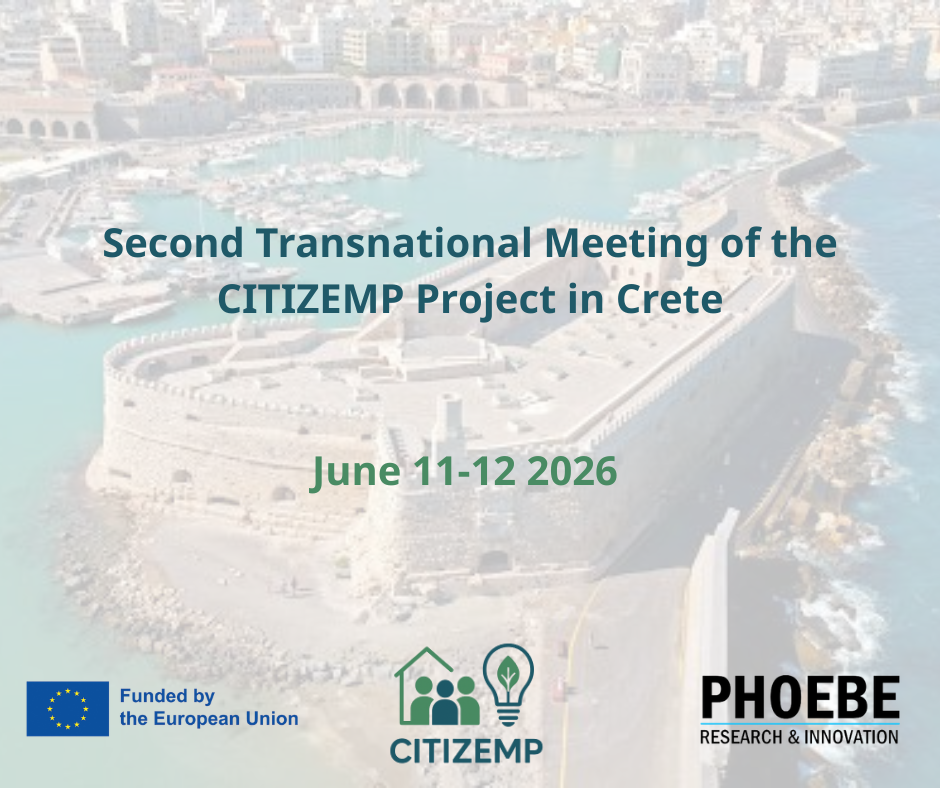
This June, something remarkable happened in the packed conference hall of the Arkalohori Conference Centre in the Municipality of Minoa Pediada, Crete. Students from local schools performed music, video, painting, shadow theatre and most memorably, a Karagiozis performance reimagined around the theme of energy autonomy. The common thread running through every performance was the same: that renewable energy, drawn from the sun, the wind and the local land, belongs to the community.
The event was organised by CITIZEMP partner Minoan Energy Community (MEC), under the banner of the CRETE VALLEY project, a living demonstration of how a broad-based energy community can function in practice. But what made the occasion particularly significant for CITIZEMP was the presence of a special guest: Alexis Chatzimpiros from the Samsø Energy Academy in Denmark.
Samsø is, by any measure, one of the most important reference points in the global community energy movement. This Danish island of roughly 4,000 inhabitants became 100% energy independent in less than five years, not through government mandate but through community buy-in, resident by resident, farm by farm, wind turbine by wind turbine. The Samsø model is not simply an energy success story. It is a story about what community readiness, fully realised, looks like at scale.
And it is not coincidental that Samsø, and the Academy that preserves and shares its lessons, provided inspiration for CITIZEMP when the project was conceived. When Alexis Chatzimpiros travelled two days from Denmark, to be present in Arkalohori for just two hours, he brought with him a living proof of concept: that communities anywhere, if they organise themselves with clarity and collective purpose, can reshape their own energy reality.
Collective Action Is Not Optional
There is a phrase in the Community Energy Pathways article that deserves to be quoted directly: communities need "a sense that collective action can make a difference." This is not motivational language. It is a structural observation about how energy transitions succeed or fail.
Individual action matters. Households that install solar panels, switch to heat pumps or reduce consumption make a genuine contribution. But the energy transition at community scale, the kind that changes what is possible for an entire neighbourhood, village or municipality, requires something more. It requires people to act together, to share risk and benefit, and to build institutions that outlast any single project or any single activist.
This is why CITIZEMP's model centres on energy communities rather than individual consumers. It is why we are investing in training Energy Champions who can sustain local engagement beyond the life of the project. It is why our phygital hubs are designed to be community-owned spaces rather than project outputs. And it is why the Samsø story, a community that made a collective decision and held to it, continues to resonate across Europe and beyond.